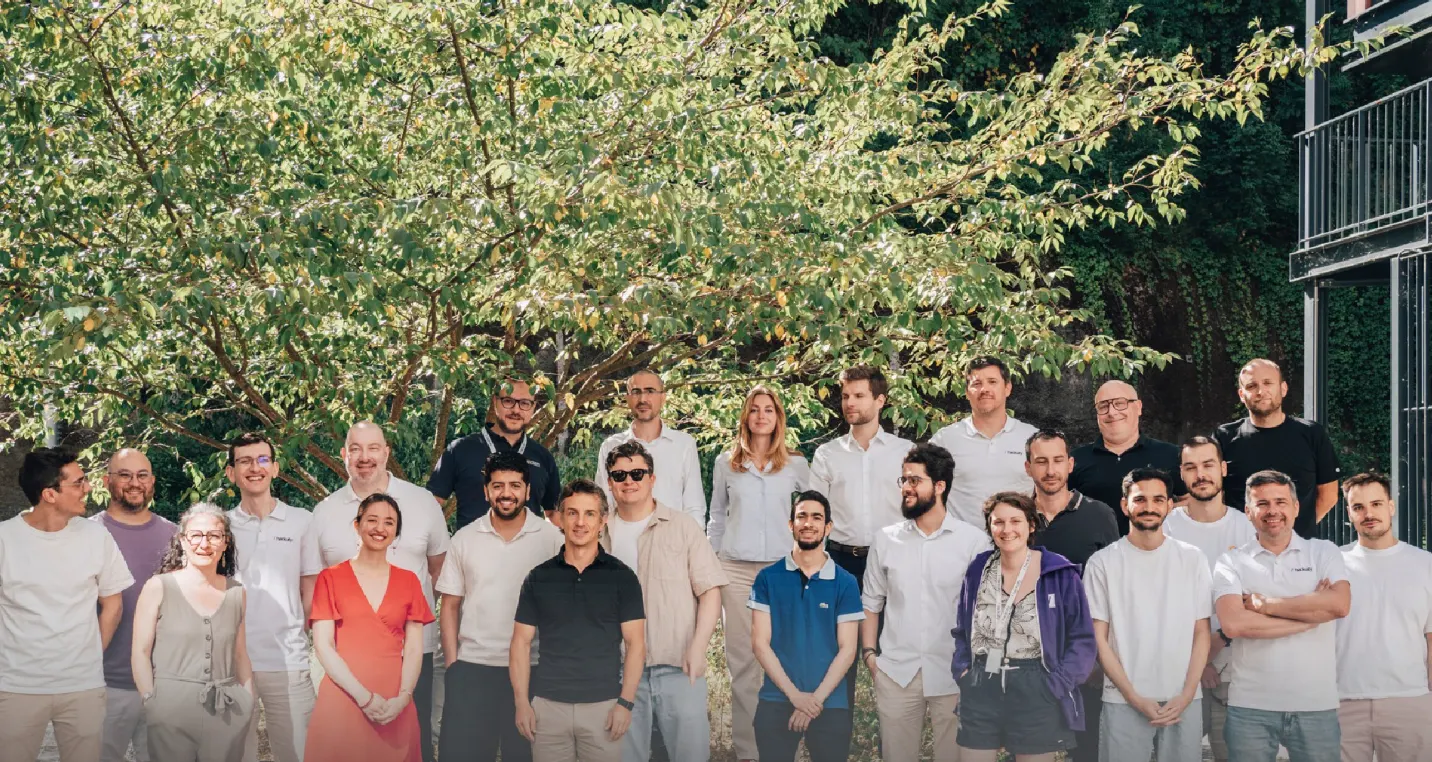

33N Ventures is a European venture capital firm specialized in cybersecurity, AI, and dual-use defence. The firm was founded by Carlos Alberto Silva and Carlos Moreira da Silva, building on a long track record of investing, operating, and scaling technology companies across Europe, the US, and the Middle East.
33N backs early-growth companies with the ambition to scale globally. With the launch of the 33N Growth Fund, this support now extends beyond Series A and B into later growth.
Fund strategy overview
Geography: global, with special activity in Europe, North America, and the Middle East
Preferred industries: cybersecurity, AI, and dual-use defence
Investment ticket: typically €4–12 million for Series A and B, and up to €20 million for growth opportunities, always keeping the flexibility depending on stage, round structure, and ownership
Company stage: Series A and Series B for the early-stage fund. Through the 33N Growth Fund, we also invest at growth stages — from Series B+ to Series D.
Product type: AI-native infrastructure, cybersecurity products, and defence-relevant software
Product stage: live commercial product, validated ideally by enterprise, with evidence of repeatable demand
Revenues: typically €1–10 million ARR for early-stage investments, with particular attention to ARR quality, retention, gross margin, and capital efficiency
Q&A with Carlos Moreira da Silva, founder and Managing Partner
What are the 5 main things you look for in a startup?
- Founder-market fit: the team needs to understand the problem deeply, have the credibility to win in the category, and show the ability to attract exceptional talent.
- Market urgency: in cybersecurity, AI, and dual-use defence, timing matters. We look for problems that are already painful, budgeted, and strategic for customers.
- Product differentiation: we need to see why the company can become a global category leader rather than another feature, services layer, or AI wrapper in a crowded market. Equally important, that differentiation must be sustainable: we look for a long-term moat that preserves the company's edge into the future. We value deep technical expertise alongside the business capacity to build the next market leader.
- Commercial validation: revenues, customer quality, retention, pipeline conversion, and sales efficiency matter because they show whether the market is pulling the product. Strong channel partnerships are a big plus — they show the company is moving beyond founder-led sales.
- Scalability: the company needs a credible path to international expansion, durable gross margins, efficient go-to-market, and a clear route to a large strategic or financial outcome.
What disqualifies a startup as your potential investment target?
The obvious disqualifiers are being outside our investment thesis, geography, stage, or business model. We are not generalist investors; we need to see a strong fit with our core strategy.
Beyond fit, the main red flags are limited technical differentiation, unclear customer urgency or weak retention, a cap table that makes future financing difficult, or a valuation that is disconnected from traction.
In today’s market, we are also careful with companies whose AI positioning lacks clear workflow ownership or a proprietary data advantage. In dual-use defence, we also look carefully at whether the company has a credible path through procurement cycles, regulatory complexity, and international scaling, as well as a credible path to commercial demand beyond one-off government contracts.
What in your opinion differentiates the best founders from the rest?
The best founders combine technical depth with commercial clarity. They are close enough to the problem to build something non-obvious, but pragmatic enough to understand what customers will actually buy, deploy, and renew.
The best founders understand not only the problem they are solving, but also the ecosystem dynamics — and how they intend to win the competition and stand out as a global category leader. They are also unusually honest about risk. They do not hide what is not working; they isolate the issue, learn quickly, and keep moving.
Our philosophy of investment is commonly referred to internally as a marriage: We are here to stick with them through the hardships and celebrate the achievements.
The best example is Arctic Wolf, where we have been on the board for 8 years and counting. Our mindset is that any investment is a commitment through thick and thin.
In our sectors, the best founders can sell to demanding enterprise customers, attract world-class talent, navigate long sales cycles, and still keep the company focused. They are ambitious without being delusional, and no matter how good things get, their hunger remains.
What should startups take into account before making a deal with a VC fund?
Founders should understand that venture capital is not just financing; it is an operating commitment. Once you choose to raise with a VC, the company is implicitly choosing a path that requires building a strong partnership and trust for the long term.
On the practical side, three things matter most:
- showing a unique positioning and creating value fast enough to earn the next round,
- building governance discipline early,
- planning the full journey, including how the company will be funded through later stages and what a credible route to a large exit looks like.
Founders should assess whether the fund understands the category, can help with customers and partners, has follow-on capacity, can support future fundraising, and will be useful when things are difficult — not only when the company is performing well.
This is one of the reasons we created the 33N Growth Fund: founders who partner with 33N get not just an early-growth investor, but potential support through the later stages. And for the companies we invest in at a later stage, we can equally add value: founders can count on 33N as a relevant investor even in later stages.
We believe one key thing is the personal relationship: even a very good company on paper might be a mismatch because the founder and the VC might not be aligned in vision and the way they work.
Alignment on ambition, ownership, governance and time horizon is more important than optimizing only for valuation. This is particularly true in cybersecurity, AI and dual-use defence, where domain knowledge, buyer access and credibility with strategic stakeholders can materially affect the company’s trajectory.
What is your approach to startup valuation and preferred share in the company?
We approach valuation from fundamentals rather than hype. We look at four things above all:
- the size and growth of the market,
- the quality of the revenue,
- the strength of the team,
- and what comparable transactions tell us about strategic scarcity.
A company may deserve a premium if it owns a critical workflow, has strong technical defensibility, benefits from structural market tailwinds, and is growing efficiently in a large category. But we are disciplined: valuation needs to support the next financing round and still leave room for venture-scale returns.
We prefer meaningful minority ownership, generally targeting more than 10% at entry in early stages and 5% in later stages, where possible, and prioritize board membership.
That said, we do not optimize for the lowest possible valuation. The right deal is one where the company is properly capitalized, founders remain motivated (ESOP is a key concern when negotiating terms), the next financing round is credible, and the entry price still allows the fund to generate strong returns.
How do you support your portfolio companies?
Our support is hands-on and sector-specific. It concentrates on three areas where a specialist investor can genuinely move the needle:
- commercially, we open doors to enterprise customers, channel partners, and reference buyers.
- On talent, we help attract leadership, putting the team in contact with the right people from our network.
- On capital, we work at board level on strategy, support future fundraising, including introductions to later-stage investors, and prepare companies for eventual exit opportunities.
We can help founders pressure-test product positioning, understand buyer behaviour, benchmark against global category leaders, and avoid common mistakes in enterprise, government and defence-facing go-to-market.
Our network is key in this process; not only does it often lead to leadership talent for the company and potential customers, but also to key insights on the market and feedback on product and approaches.
Our value is strongest where capital, category knowledge and network access combine. We aim to be useful from day one, not only at board meetings. And our commitment does not end with the first cheque: through the 33N Growth Fund, we can keep backing our companies in their later-stage rounds. We are not an invest-and-forget firm — we are structured to be a partner for the whole journey, from Series A to global category leadership.
What are the best-performing companies in your portfolio?
We prefer not to rank portfolio companies publicly, but Exein is a strong example of the type of company we want to back. 33N led its €15 million Series B in 2024, and in 2025 Exein raised €100 million.
And just recently, Exein raised $270 million in a funding round led by Headline, valuing the company at $1.7 billion.
The company’s growth reflects the acceleration of the embedded, IoT, and device-level security market, where Exein has become one of Europe’s most visible category leaders.
Acoru is another strong example of our conviction-led approach. We pre-empted the company because we saw a clear market need around fraud prevention and account-level intelligence, and it has since grown massively, validating both the urgency of the problem and the quality of the team.
And Apono deserves a special mention: it became our first exit in the current portfolio when it was acquired by 1Password in June 2026, just seven months after our investment. Beyond the speed of the outcome, it validates our thesis on securing human, machine, and agentic identities in the AI era, and shows how decisively strategic buyers move for category-defining teams.
What are your notable lessons learned from investments that didn’t work out as expected?
In the current fund, we have not had a major negative outcome, but every company goes through challenging periods, and we invest with that reality in mind. One major lesson is that timing matters as much as technology. A technically strong company can still struggle if the market is not ready, if budgets are not yet allocated, or if the category is too early for repeatable sales.
Another lesson is that productisation matters. In cyber and AI, it is easy for a company to drift into services-heavy revenue because customers have urgent needs. That can create early traction, but it may also reduce scalability and gross margin quality if not managed carefully.
A third lesson is that go-to-market complexity should not be underestimated. Enterprise customers can create large outcomes, but sales cycles, procurement, compliance, and trust-building need to be built into the plan from the start.
Finally, governance and capital discipline matter. Too much capital before repeatability can create a cost base that the company cannot support. The best companies learn fast, stay disciplined, and only scale once there is evidence that the go-to-market motion is working.
What are the hottest markets you currently look at as VC and where do you see the biggest hype?
Our focus clusters around three themes:
- AI-native security: autonomous cyber operations, data security and governance for AI, and identity and access in an agentic enterprise.
- Securing the software fabric: API and application security, and software supply-chain security.
- Defence software and dual-use technologies that can serve both commercial and government customers.
We are also exploring the rapidly expanding space around industrial automation and physical AI in general and the emerging need for post-quantum readiness.
The biggest hype is in generic “AI for security” companies that do not own a real workflow, do not have proprietary data, and cannot prove measurable productivity or detection improvements. We are also cautious around broad agentic AI claims where the product is effectively a thin orchestration layer rather than a defensible system.
In dual-use defence, the opportunity is real, but not every defence-labelled company is venture-backable. We look for companies with scalable software or technology products, credible procurement pathways, international relevance and the ability to serve large markets beyond one-off projects. We favour companies that can capture real synergies between the civilian and defence worlds, benefiting from exposure to both sides, not just selling to both.
In your view, what are the key trends that will shape the European VC scene in coming years?
The European VC scene will be shaped by the convergence of cyber, AI and defence. As we framed it at our 33N Connect Day 2026:
AI is moving from experimentation to deployment; security has moved from an IT concern to a boardroom priority, and defence has moved from the background to the centre of strategy.
This creates a new generation of companies to back. AI expands the attack surface through new models, agents, workflows, integrations, and data flows, while also giving attackers better tools to move faster and at greater scale. The winners will build the trust layers, security infrastructure and defence-relevant technologies needed for this new environment.
For Europe, the opportunity is to create global champions in cybersecurity, AI and dual-use defence. That requires specialized capital, deeper sector networks and investors who can support the best companies for longer as they scale from early growth into category leadership, something that Europe has historically lacked and that the 33N Growth Fund was created to help close, keeping European champions backed by European capital as they scale.