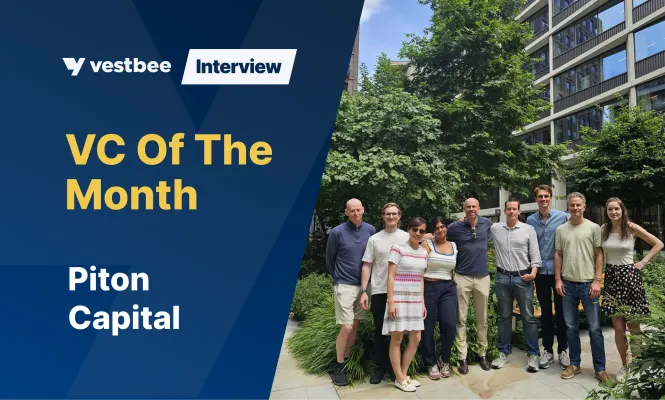


London-based Piton Capital is a geography- and industry-agnostic fund that invests in companies with strong network effects, predominantly at seed and Series A. Some selected portfolio companies and exits include Auto1, FanDuel, Treatwell, ManoMano, Docplanner, Watchfinder, and Booksy.
Fund strategy overview
Geography: Europe and, opportunistically, worldwide
Preferred industries: industry-agnostic
Investment ticket: targeting €3 million, but can be flexible
Company stage: seed, Series A, but can also go earlier or later
Product type: strong network effects, both B2B and B2C
Product stage: ideally post PMF, with tested GTM
Revenues: not required, but usage and momentum must be strong. Test of monetization is good to have
Q&A with Mira Mihaylova, Partner at Piton Capital
What are the 5 main things you look for in a startup?
- A potential for strong network effects
- Outstanding team
- Proven PMF
- Tested GTM
- Either a big market or a small market that can act as a logical launchpad/wedge into a big market
What disqualifies a startup as your potential investment target?
No potential for network effects, pre-launch, or very little traction (pre-PMF).
What in your opinion differentiates the best founders from the rest?
Passion and obsession, intensity, strategic clarity, ability to attract and inspire talent, resilience, great communicators, strong founder-market-fit (different constructs call for somewhat different founder types).
What should startups take into account before making a deal with a VC fund?
This is a long-term partnership, so the team needs to choose the right partner — the one they want to work with for many years to come.
What is your approach to startup valuation and preferred share in the company?
We base the valuation on the current traction of the company, the risks we see, and the potential exit scenarios. We target an entry price that gives us an attractive risk/reward profile based on the likelihood of these different exit outcomes.
How do you support your portfolio companies?
When the team is asking for advice on a particular topic or strategic direction, and we have relevant experience from our long history working with entrepreneurs of all shapes and forms, we always try to help as much as possible.
The differentiated value we add on top of this is our pattern recognition with network effects constructs and playbooks — we can help founders navigate the challenges in building a dominant, highly defensible business. Sometimes this involves attacking an established old-school player with network effects, which can be very difficult to tackle head-on.
What are your notable lessons learned from investments that didn’t work out as expected?
- Too much money can destroy companies — lack of focus, confusing PMF signals, etc.
- Premature expansion either internationally or into adjacent areas
- Irrational competitors in a market abundant with money can ruin the economics for everyone, by ultimately paying more to acquire a market that it is actually worth.
- Teams that fail to attract the right talent around them
What are the hottest markets you currently look at as VC and where do you see the biggest hype?
We are not hype driven as an investor, and our hot themes rarely change with what is hot in the market. For us, the hottest one has always been and remains a company with a potential to develop strong network effects — this usually leads to outcomes that are very dominant, highly profitable, and very defensible at scale.
Currently, we are looking for markets and business models that are resilient to AI — in other words, where “Claude will not be able to build this.” Examples include unique, proprietary datasets, such as Vesper; marketplaces with access to differentiated supply, often secured by providing workflows for that side of the market, as with Ovoko; social or collectibles-based models built around a passionate topic or hobby, such as Cardnexus; and forms of intelligence that are not language-based, including AI models for physical simulation.
Of course, we also like the other side of this trend: business models that directly benefit from the latest developments in AI, such as many B2B principal-model marketplaces.
In your view, what are the key trends that will shape the European VC scene in the coming years?
The European ecosystem has matured to the point where it can produce very large outcomes, supported by strong talent and seasoned operators. AI may also level the playing field between Europe and the US to some extent. Certain areas play particularly well to Europe’s strengths, including robotics, industrial technology, and physical AI, while parts of the region also benefit from clear cost advantages.
At the same time, structural frictions remain, including long employee notice periods, limited labour mobility, and the lack of a unified European framework.