
As AI makes it faster to build software, keeping track of what has changed — especially for people outside engineering teams — is becoming a challenge of its own.
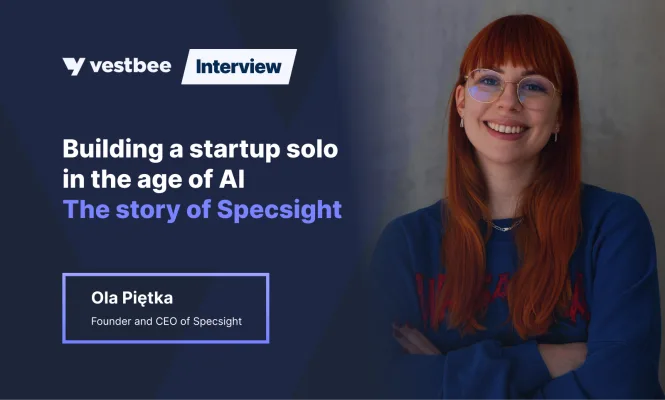
That's the problem Ola Piętka wants to solve with Specsight, a platform she launched in April 2026 to help non-technical teams understand how their product works and what changes with each release, without having to read code or ask engineers to explain every update. She built it without employees, relying instead on a “team” of AI agents to handle much of the work. Her ambition is to build a billion-dollar company from Poland as a solo founder.
Vestbee spoke with Piętka about how Specsight works, what early customer feedback has taught her, and how far AI agents can take a one-person startup.
Translating the code into business language
Before founding Specsight, Piętka worked at legal and government technology startups. At each, non-technical colleagues came to her with questions about how a product worked or what had changed. The answers were usually in its code. "I had to stop everything that I was doing and basically translate code to business", she recalls. As AI coding tools accelerated development, she says, keeping up with changes became difficult even for engineers.
Specsight aims to automate that translation. Customers connect a GitHub or GitLab repository; the platform analyses features, user flow, and product behaviours, then tracks what changes with each release. For example, if a product increases its file-upload limit from 10 MB to 100 MB, Specsight is designed to show the change in user-facing terms rather than lines of code. It can also generate internal digests and release notes.
Piętka argues that code is a more accurate record of what has been built than tickets or documentation, which may describe intentions rather than the finished product. That makes accurate interpretation of a complex codebase essential to Specsight's value.
From MVP to paying customers
The first MVP was ready in April 2026; sales began in June. To find paying customers, Piętka reached out to prospects through hundreds of LinkedIn messages each week, events, and product demos. "I never sold anything before. I didn't know how to find clients; I didn't know how to talk about the product, how to price", she says.
Specsight targets B2B software companies with 20 to 200 employees in Europe and the US, especially those shipping frequently with AI. Since June, Piętka has closed five deals and started two new pilots, although some early customers have cancelled. As she explains, those who left still saw value in Specsight but didn't want to log into yet another dashboard. Instead, they preferred updates through tools they already use, such as email, Slack, or AI assistants.
"People are drowning in tools," Piętka says. "Nobody wants one more login, one more tab, one more place to check."
Their feedback has prompted Piętka to rethink how Specsight delivers information. Rather than relying on a standalone dashboard, the platform now allows users to access product information directly through AI tools, like Claude, with email-based updates planned next.
Alongside these changes, Piętka is now moving towards a self-service sales model. Some customers have already subscribed through the website after discovering Specsight on LinkedIn, without speaking to the founder. They can also connect their GitHub or GitLab repositories themselves, a process Piętka says takes about two minutes. The startup currently offers a €150 monthly subscription per organisation, covering up to three projects, 50 members, and 200 releases a month. Larger teams would receive custom pricing.
However, giving access to customers' code also raises security questions. Piętka says Specsight uses read-only access, and that code analysed through Anthropic's Claude API is deleted afterwards rather than stored. She is now working towards security standards such as SOC 2 or ISO certification, which she sees as important for attracting enterprise customers.
An AI team still needs people
Piętka runs Specsight without employees, relying instead on AI agents to handle much of the work.
"I like to say it's myself and I, and my team of AI agents", she says, smiling.
She uses Claude, ChatGPT, and occasionally Gemini, alongside small applications she builds herself, to automate tasks across development, marketing, sales, and operations.
For instance, one agent researches potential customers and qualifies leads, while others prepare outreach messages, meeting briefs, and follow-ups. Piętka has also automated parts of her fundraising process, using AI to screen more than 3,000 VC firms for potential investors.
But she draws the line when human interaction is involved. Once a prospect replies to an outreach message, she takes over. AI also reviews her sales call transcripts and suggests improvements, but she handles customer conversations and important decisions herself. "I don't want people to talk to AI. People should talk to me", Piętka explains.
Her reliance on technology extends to everyday habits. She uses voice dictation instead of typing to save time, so frequently that, as she puts it, her boyfriend makes fun of her for talking to her computer more than to him. Still, having an AI team hasn't translated into shorter working hours: "I'm just doing work for sure; I don't have time for relaxing", she admits.
And despite her solo-founder ambition, she doesn't intend to remain alone indefinitely. Piętka wants to hire a product engineer and someone to lead commercial operations. She is currently seeking €850,000 in pre-seed funding from European and US investors to support these hires and develop Specsight further.
Beyond tracking changes
Ultimately, Ola Piętka wants Specsight to become a "control center" for companies building software with AI, helping teams verify changes made by coding agents and assess their impact on the business. Today, she says, Specsight is in an "observability" phase, focused on understanding what has changed in a product. Monitoring and broader control capabilities remain in the roadmap.
Asked why GitHub or another developer platform could not build something similar, she points to Specsight's focus on business users and the challenges of interpreting large, messy production codebases. Whether this focus can become a durable competitive advantage remains an open question.
Piętka's longer-term ambitions include expanding to enterprise customers, raising another funding round, and eventually building a global unicorn as a solo founder.
For now, Specsight is an early-stage business adjusting its approach in response to early customer feedback. The next test is whether non-technical teams find its updates valuable enough to keep paying for them, especially when delivered through tools they already use, and whether Specsight can maintain that value as customers’ codebases grow.