
Osavul began operating in 2023, initially focusing on detecting disinformation campaigns. Three years later, the Ukrainian-founded company has expanded its work to include cyber threats, espionage, and the identification of potential physical attacks.
Government and security institutions make up most of Osavul's customer base, though the company is also growing its corporate business. It recently closed an €8.5 million Series A round backed by international cybersecurity and defence tech investors, with plans to expand further into the corporate market.
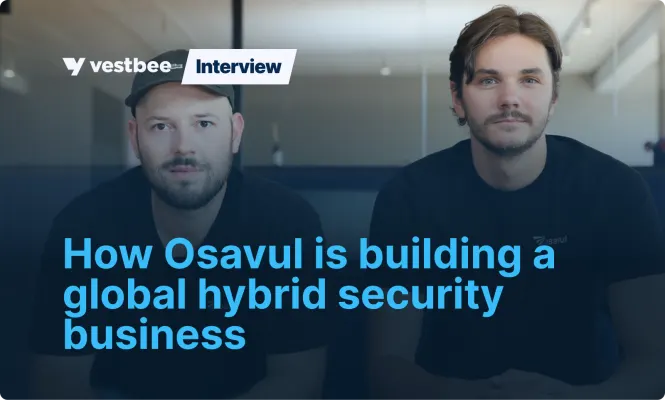
We spoke with Dmytro Bilash, Osavul's co-founder and CBDO, about why the company moved beyond disinformation, the challenges of winning government contracts, and how its Ukrainian experience helps it compete internationally.
A strategy of a thousand cuts
Osavul's move beyond monitoring disinformation came from what its team saw in practice — information campaigns were often a part of wider operations involving cyber and physical threats.
Bilash uses Russia's activities in Europe to illustrate the point. An operation aimed at influencing elections might combine disinformation with support for extremist groups or cyberattacks. Sabotage, meanwhile, can be paired with an information campaign that serves political goals.
For those behind such operations, the distinction between cyber, information, and physical threats matters little. As Bilash explains, this approach is effective because each incident can cause damage without being serious enough to provoke a military response. He describes this as a strategy of "a thousand cuts".
Osavul now analyses digital signals that may indicate preparations for an attack, such as creating online infrastructure, testing of tools, or recruitment activity.
"No operation today happens completely unnoticed", Dmytro Bilash says. But a single signal rarely provides enough evidence to act. "If an analyst looks at each signal separately, it won't trigger action. But when you start putting these pieces together, a picture emerges", he explains.
One case Bilash points to involves a suspected LinkedIn-based espionage operation targeting NATO and EU employees. He says Osavul identified signs of preparations involving fake recruiters who would approach potential targets with job offers and try to obtain sensitive information.
Weeks later, in March 2026, media reported on a similar scheme involving fake LinkedIn profiles, which European security sources attributed to Chinese intelligence. Osavul says its earlier assessment pointed to Russian-linked actors, although no independent confirmation shows the company identified the same operation.
Osavul's NATO-related work
As Osavul expanded its technology, it also built a business selling to security institutions worldwide. Europe remains its largest market, though the company also works in the Americas and Asia. It also contributes technology to the Brandwatch-Blackbird.AI consortium selected by NATO to deliver its Information Environment Assessment Capability.
Winning contracts with security institutions is not straightforward, particularly for a relatively young company like Osavul, which has been operating commercially for roughly three years. Bilash notes that securing a single government contract can sometimes take just as long. But once a company breaks into the market, the lengthy sales cycles and barriers to entry, often seen as bottlenecks in the defence tech industry, can become a competitive advantage.
Osavul's co-founder doesn't see the company's NATO-related work as something unusual. "Take any large contractor from the UK or US — they have dozens of contracts. It's a capability you build", Bilash emphasises. That ability to work with institutional customers has also helped the company raise investment. "At Series A, you can no longer sell an idea. You have to show how it works: a real business, real numbers, contracts", he says.
For its latest round, Osavul chose specialist investors: cybersecurity-focused 33N Ventures, which led the round, defence and dual-use fund Balnord, and Germany-based G+D Ventures, alongside existing investor 42CAP. According to Bilash, the round was oversubscribed, with more investors interested than the company could accommodate.
Ukraine is not a testing ground
Although Osavul's business has been international since 2023, Ukraine remains an important part of its operations. The company continues to employ analytical and R&D teams there.
Bilash draws a clear line between the company's commercial activities and the work it does in Ukraine, where, he says, almost all services are provided as support rather than paid contracts: “We make business around the world, and in Ukraine we deliver the mission”.
He also takes issue with how the defence tech industry often portrays Ukraine.
"I really dislike this idea of Ukraine as a testing ground. It's a terrible concept. This idea shouldn't be promoted, and the security industry should focus more on delivering value rather than testing", he says.
Still, that experience gives Osavul an advantage when selling abroad. Many employees have firsthand experience of the threats that security institutions elsewhere are now trying to understand and counter. "We know what real war and hybrid threats look like — not from a report or a two-week visit,” he says, adding that this practical experience also helps Osavul build trust with clients.
Beyond government customers
Government contracts remain the core of Osavul's business. But over the past year, the company has seen growing demand from the private sector, particularly among critical infrastructure operators. Bilash attributes this to rising security threats and new regulations that are putting greater pressure on businesses to protect themselves.
Osavul now plans to build on that demand and expand its corporate customer base.