
Robin Haak has spent much of his 15-year investment career working with enterprise software companies. Now, with the launch of Robin Capital’s second €15 million fund, he is placing greater emphasis on robotics, defence, and space. But while his investment focus is evolving, his approach to running a VC firm remains the same — relying on a trusted network of investors and experts and spending most of his time working directly with founders.
In our interview, Haak explains how he evaluates technologies beyond his own expertise and why being a solo GP doesn't mean doing everything alone. We also discuss Robin Capital's first investment in Ukraine, his growing ties with CEE backers, and his long-term ambition to build a €100 million growth fund.
What have you learned from Fund I, and is there anything you’re planning to do differently with Fund II?
I’ve been investing for around 15 years, and I think the longer you do this, the more you realise how difficult it is to predict the future. Particularly at pre-seed and seed, where you’re often backing people before there’s much evidence that their vision will work.
Fund II is an evolution rather than a reinvention. We’re placing greater emphasis on companies with lasting competitive advantages, particularly in enterprise AI, robotics, defence, space, and deeptech.
We’ve also continued improving how we support our founders. Our annual gatherings have grown, we’ve introduced founder retreats, and we’ve strengthened our network of venture partners and experienced operators. Much of this has come from listening to founders and learning what they actually need.
Your LPs include unicorn founders and experienced VC and PE investors. What convinced them to back a solo GP? Are they involved in supporting your portfolio companies?
I think it comes down to trust, which is something you earn over time. Many of our LPs have known me for more than a decade. We’ve invested together, worked together, or met when I was raising growth capital as an operator. They’ve seen me on both sides of the table, through good times and difficult ones.
For some of these investors, Robin Capital was too small for their institutional mandates. But they were willing to invest personally because of the relationships we’d built over the years. That meant a great deal to me.
Our LPs meet our founders, attend our gatherings, exchange ideas, make introductions, and share their experience. And increasingly, these relationships develop independently of me.
You’ve been expanding beyond enterprise software and AI into robotics, defence and space. Why?
It’s more an evolution of our thinking than a change in mandate.
AI has made it possible to build software companies faster and with fewer resources than ever before. I think we’ll see some extraordinary companies emerge from this wave. But I wonder whether certain businesses, particularly those serving fragmented SME markets, might grow very quickly before discovering that maintaining their competitive advantage is much harder than achieving their initial growth. As venture investors, we need to think carefully about what makes a company truly enduring.
So we’re becoming more deliberate about defensibility. That might come from proprietary technology, deeply embedded customer relationships, complex workflows, specialist expertise, or the difficulty of replicating a product in the physical world. Naturally, this leads us towards robotics, defence, space, deep tech, and certain areas of enterprise AI.
But we remain close to our roots. Enterprise go-to-market is something we understand well, and even the most sophisticated technology company eventually needs customers, talented people, and a way to build a sustainable business.
Your background is mainly in enterprise software, but you’re now investing in quite specialised defence technologies. How do you evaluate these startups?
Well, I certainly don’t know how to build a rocket, and I think everyone should be quite relieved that nobody has asked me to. But I can learn enough to understand the important technical and commercial milestones, evaluate the business opportunity, and ask whether a team has the ability to execute.
More importantly, I know when to ask people who understand something far better than I do.
We’re fortunate to have experienced venture partners, a broad network of operators and specialists, and relationships with excellent investors across different industries.
We collaborate, exchange perspectives, speak with customers and technical experts, conduct reference calls, and challenge our assumptions. Of course, we still need to develop our own conviction. But I don’t see any virtue in pretending that good investment decisions have to be made in isolation.
And once we’ve invested, the support I personally provide is surprisingly similar across industries. Whether a founder is building enterprise software, robotics, or space technology, they eventually face questions around hiring, enterprise sales, go-to-market, financing, customer relationships, and organisational growth.
These are areas where I’ve spent much of my professional life, both as a founder and an operator.
Defence startups often face long procurement cycles and challenges finding their first customers. What do you look for at the pre-seed or seed stage? And what would make you pass on a deal?
Defence wasn’t originally a sector I planned to specialise in. In fact, my first investment came about rather organically. In Fund I, we had reserved a small allocation for opportunities outside our traditional focus. I jokingly called it our YOLO bucket. That’s how I became involved with ARX Robotics.
Through ARX, I met remarkable founders, engineers, investors, and people with deep experience in the sector. One relationship led to another, and over time we began seeing more opportunities. But I wouldn’t describe myself as a specialised defence investor. It’s one of several sectors we find interesting.
Our investment criteria remain quite consistent:
- First, the founders. Do we believe they have the character, ambition, technical ability, and resilience to build something difficult?
- Second, the problem. Is there a genuine customer need, and can we validate it with people who understand the market?
- Third, execution. Can the team move from an interesting technology to a product that can be tested, adopted, and eventually purchased?
What would make us pass? If we couldn’t develop sufficient conviction in the team, validate the underlying need, or understand a credible path towards building a sustainable business. And sometimes we simply don’t understand an opportunity well enough. I think it’s perfectly fine to admit that and move on.
What about Central and Eastern Europe, particularly Poland and Ukraine? Are you actively looking at startups there? Have any caught your attention?
Absolutely. I have a great deal of affection and respect for Central and Eastern Europe, particularly Poland and Ukraine. We’ve recently made our first investment in Ukraine, SkySpy, and we’re collaborating with the Polish investment firm Expeditions. I’ve also spent time in Warsaw recently, and we have LPs from the Czech Republic.
Poland is especially interesting. Its economic development has been remarkable, and I believe the entrepreneurial ecosystem has a great deal of potential.
Ukraine is particularly close to my heart. I’ve been personally involved in supporting people there for several years, including educational initiatives. Through that experience, I’ve met people whose courage and determination have left a lasting impression on me. I don’t want to romanticise their circumstances. Building a company is difficult anywhere, but building one during a war requires a level of resilience that deserves enormous respect.
You’ve already set up growth SPVs for Almetra, ARX Robotics and Ground A. How do you decide which companies to back further? And what’s the plan for the dedicated growth continuity fund?
One of the things I enjoy most about early-stage investing is the opportunity to accompany founders over many years.
We’ve established growth SPVs for ARX Robotics, Almetra, and Ground A because we wanted to continue supporting these companies beyond the stages our core funds are designed for. Of course, every new investment decision has to make sense independently. But when founders continue to execute, build stronger businesses, and earn our conviction over time, we’d like to have the opportunity to keep supporting them. And fortunately, many of our LPs share that interest.
Longer term, I could imagine establishing a dedicated growth continuity fund, potentially €100 million or more. The idea would be to first build three early-stage funds and a portfolio of roughly 80 to 90 companies.
Over time, some of those companies will hopefully develop into exceptional growth-stage businesses. Rather than discovering these businesses for the first time during a Series B or C, we might already have worked alongside their founders for years. We’d understand their journey, the people, the challenges, and the decisions that shaped the company. That doesn’t make future outcomes predictable, but it can give us a much deeper understanding of the businesses we’re considering.
For now, it’s a long-term ambition rather than something we’re rushing towards.
Speaking of three early-stage funds, why €15 million per fund? Have you considered raising larger funds?
Of course. But I’ve never believed that raising more money automatically makes you a better investor. For the model we’re building, €15 million is a very sensible fund size. It allows us to write meaningful early-stage cheques, build a diversified portfolio, and remain flexible and collaborative when investing alongside other funds.
Our funds have a €15 million target and a €30 million hard cap. I believe the strategy can work well within that range. Beyond a certain size, the model changes. You need to deploy more capital, potentially invest in more companies, or start writing significantly larger cheques. That can lead you towards a different strategy, with more competition for allocations, more responsibilities, and a larger organisation.
There’s absolutely nothing wrong with that. Some of the world’s best venture firms have built extraordinary businesses that way. It’s simply not the model I’m trying to build right now. If we build three focused early-stage funds, we’ll hopefully have a portfolio of around 80 to 90 companies, a wonderful community, and a strong foundation for whatever comes next.
A larger growth platform might eventually make sense, but that would be a different strategy, with a team and structure designed for it.
In the interview with Tech.eu, you’ve said you want to spend most of your time working with founders. But as a solo GP, how do you manage everything else — sourcing deals, due diligence, fundraising? And how will that work as your portfolio grows?
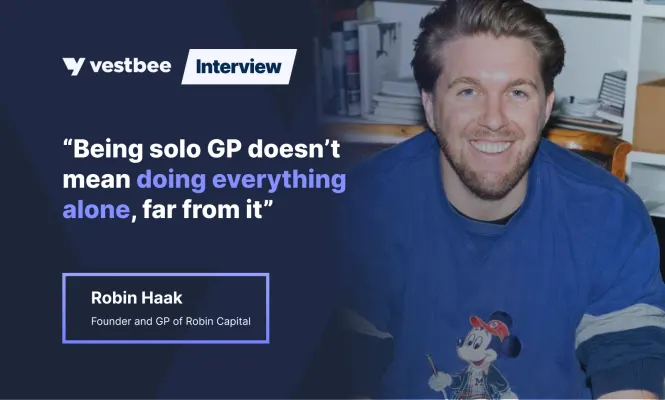
I think there’s sometimes a misunderstanding about what being a solo GP actually means. It doesn’t mean doing everything alone, far from it. I’m incredibly fortunate to work with a small, dedicated team, experienced venture partners, operating specialists, and a community of founders and LPs who are generous with their time and knowledge.
Much of our deal flow comes through relationships developed over many years. We also work closely with other investors, exchange perspectives, and benefit from a community where people genuinely enjoy helping one another.
We’re deliberate about where we spend our time and selective about the investments we make. Today, I spend roughly 70% of my time working with portfolio companies. It’s the part of the job I enjoy most, and I want to preserve it.
Technology is also making it easier to run lean organisations. AI tools and agents can increasingly support research, administration, reporting, and many other processes that previously required significantly more resources. Of course, as we grow, the organisation will evolve too. We may add more people to support founders, strengthen the investment team, or eventually bring in partners for a dedicated growth strategy.
But I do want to protect the original idea behind Robin Capital. I’ve been a founder myself. I know that building a company can be an incredibly lonely journey. Sometimes what you need most isn’t another investor giving you advice. It’s someone who listens, picks up the phone, makes an introduction, or simply stands beside you when things become difficult.
If I can offer even a little of that to the founders we support, I consider it time very well spent.