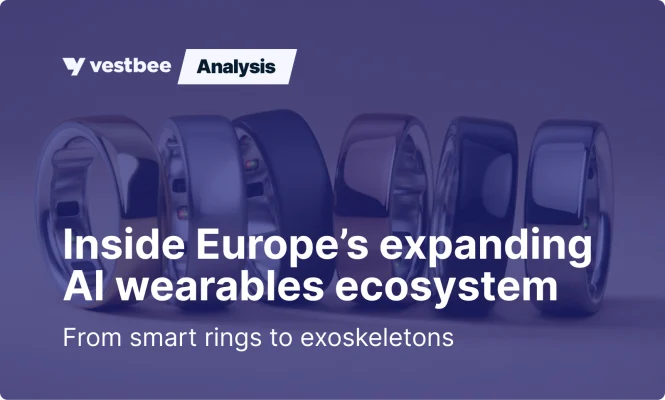

For several years, the AI wearable category revolved around a familiar promise of human optimization. Smart rings, bracelets, and bands tracked sleep cycles, steps, heart rate variability, and recovery metrics, turning the body into a continuous stream of data. Much of this market developed in the US, where consumer health tracking became a major hardware trend. Big tech is now pushing further into the space, with products like Meta's Ray-Ban Meta Smart Glasses. Europe is also catching up and beginning to generate its own set of startups experimenting with alternative approaches to the category.
But as technology advances, AI wearables are moving beyond biometric monitoring into far more intimate behavioral territory, aiming to reduce cognitive and emotional friction in daily life. Some focus on memory and productivity: wearable “second brain” systems like the Plaud NotePin or the Limitless Pendant passively capture conversations, generate summaries, and organize personal knowledge. Others explore AI companionship, such as the Friend pendant, which listens to the user’s environment and offers conversational responses or daily encouragement.
Europe’s take on the AI wearables — from smart rings to exoskeletons
Europe has already produced one of the category’s most commercially successful players. Helsinki-based Oura created a device focused on sleep, recovery, and long-term biometric tracking. The company has raised around $1.3 billion to date and reached a valuation of roughly $10.9 billion following a $900 million Series E round in 2025. More than 5.5 million rings have been sold globally, with revenues expected to exceed $1.5 billion in 2026.
In March 2026, Oura announced the acquisition of Doublepoint, a startup developing gesture-recognition technology that allows users to control devices through subtle hand movements. The technology combines biometric signals and machine learning to interpret gestures without requiring cameras or external sensors. This acquisition will help Oura reposition the ring from a passive health tracker to an active interface, where voice and gestures replace screens as the primary control layer.
We are also seeing a growing flow of venture capital into verticalized, highly specific wearable AI, as the European wearable ecosystem is expanding far beyond consumer wellness devices.
One of the most ingenious examples comes from France. Paris-based Wandercraft is developing autonomous walking exoskeletons designed to restore mobility for people with severe walking impairments. Since its founding in 2012, the company has deployed its clinical exoskeleton system, Atalante X, across more than 100 hospitals and rehabilitation centers worldwide. In 2025, Wandercraft raised a $75 million in Series D to expand beyond clinical environments and prepare for broader consumer and industrial applications. Its upcoming product, Eve, aims to be the first self-balancing personal exoskeleton that enables upright movement without crutches or walkers—powered by AI models trained on billions of simulations and millions of real-world steps.
Switzerland’s Hilo is developing continuous blood-pressure monitoring devices that eliminate the need for traditional inflatable cuffs. Using optical sensors and AI-driven signal processing, the company’s system tracks cardiovascular metrics around the clock and generates medical-grade insights for patients and clinicians. Founded in 2018, Hilo has raised more than $100 million in funding and secured a $42 million Series B round in 2025 as it expands its AI-powered cardiovascular monitoring platform.
Another emerging frontier involves biosensing technologies, such as Epicore Biosystems, which has operations in the UK and the US and develops wearable sensors capable of analyzing sweat in real time. Its Connected Hydration platform measures electrolyte levels, fluid loss, skin temperature, and movement to monitor fatigue and dehydration risks in athletes, industrial workers, and military personnel. As extreme heat events become more common globally, systems that combine biosensing hardware with predictive analytics are attracting increasing attention. Epicore raised a $6.0m Series B in 2025 at a $130m valuation.
Are you lonely? AI can be your friend
In recent months, commuters in the Paris metro have been greeted by an ad with a message: “I’ll always be there for you,” or “I will never leave dirty dishes in the sink.” The slogan appeared alongside images of a small circular pendant called Friend AI Pendant, a wearable chatbot designed to keep its user company.
This device is an especially interesting case in the AI wearables market, especially considering the public skepticism it has brought about. Friend is essentially a necklace with a built-in microphone that continuously listens to its surroundings. It communicates with its user through text messages and notifications sent to a paired smartphone, offering commentary on conversations, encouragement during everyday situations, or reflections on what the user has just experienced.
The system is designed to build a personality over time that reflects the user’s needs and adapts to their lifestyle. The company’s CEO has described the goal bluntly: the device should become not just a friend, but potentially a user’s best friend, always present and always listening. This has obviously come with consumer pushback — not just on the front that an AI-powered frictionless companion is exploiting the rising loneliness crisis — but also as privacy concerns have arisen. Critics argue the pendant’s design raises questions about consent and data collection, since it records ambient conversations in public settings. Some journalists noted that users must agree to record people around them without necessarily informing those individuals directly. The device has also caught the attention of regulators in France.
However, commercial traction for Friend remains uncertain: as it gears up for Europe’s expansion, the device has not yet launched widely, and early estimates suggest only a few thousand units have been sold in the United States so far.
Early failures show how fragile the AI wearable category still is
Not every aspiring AI wearable device has survived the realities of the market and the hardware constraints of its ideas. One of the most prominent casualties so far is the Humane AI Pin, introduced in 2024, as one of the first “AI-first” personal computers. It was a small brooch that could be clipped to clothing, with a camera, microphone, laser projector, and cellular connectivity, that projected a simple interface onto the user’s palm and relied on voice commands, gestures, and taps to interact with an AI assistant powered by large language models. The founders described the device as a “contextual computer,” meant to provide constant access to information without forcing users to look at a screen. The project unraveled quickly. In early 2025, HP acquired parts of Humane’s assets, and the company shut down its consumer service. The execution proved to be too difficult — reviews highlighted limited functionality, unreliable performance, unclear advantages over existing smartphones, and an overreliance on the cloud infrastructure.
The core idea behind the AI pin, ambient AI embedded into everyday objects, remains compelling and continues to attract experiments from both startups and large technology companies. But translating that vision into a reliable consumer device has proven far more complex. Companies are still testing what people actually want from AI hardware, beyond biometric tracking, and the next few years will show in which direction the market will move and whether consumer adoption, the tech, and the ideas will all converge into some great devices.