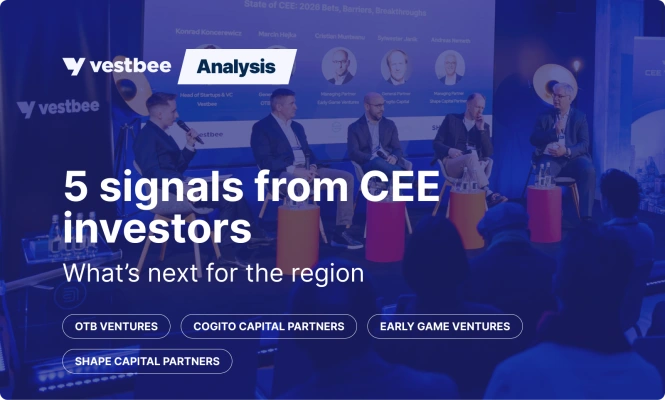

At this year’s Vestbee CEE VC Summit, one question ran through the discussions: CEE has already proven it can produce globally successful startups — but what will it take to do it consistently and at a much larger scale? Where are the real opportunities for the region? And does it have the talent to sustain it?
That’s what Marcin Hejka, General Partner at OTB Ventures, Sylwester Janik, General Partner at Cogito Capital Partners, Cristian Munteanu, Managing Partner at Early Game Ventures, and Andreas Nemeth, Partner at Shape Capital Partners, discussed during the opening panel. Here are the signals they see now.
Dual-use, defence, and space are defining sectors
If there were areas investors sounded most certain about, it was dual-use, defence, and space. For Marcin Hejka, this is where one of the region’s biggest opportunities is forming — and Poland sits at the centre of it. “I would be very surprised if we don’t see a massive number of opportunities and successes in this sector,” he said.
His argument was simple: Poland is already spending 5% of GDP on defence, sits close to the war in Ukraine, and is deeply connected to the Ukrainian ecosystem. That combination creates a new kind of startup pipeline — one driven by urgency and real-world deployment.
Another shift is just that important: a growing share of defence budgets will go directly to startups. “Primes are not fast enough to react to dynamically changing threats. Only startups can do it,” he said. What used to be a modest share of defence spending could become meaningful over the next decade.
Still, some see this as "a bitter opportunity," driven by geopolitics rather than the kind of long-term competitive logic investors would ideally prefer.
“I would love not to see the world defence sector growing. It would mean that by 2030, the war is over and the cycle has turned,” Sylwester Janik said.
Physical AI and robotics are no longer emerging sectors
Another theme was physical AI, robotics, and the type of AI built on top of the region’s engineering and manufacturing base.
Sylwester Janik pushed back on the idea that this is a sudden wave driven by hype around humanoids or industrial automation. The companies now gaining real traction were built years ago. “It’s not the response to the opportunity,” he said. “All those companies have been established years ago, and they’ve been working on building something unique.”
He pointed to Nomagic, Brightpick, Dexory, and Starship Technologies — companies that are now raising larger rounds and expanding internationally. Their emergence, he suggested, reflects structural advantages: strong engineering and manufacturing traditions across countries such as Poland, Romania, Estonia, and Slovakia.
In that sense, physical AI in CEE is less about what’s coming next — and more about what is already starting to scale.
AI-native services could be one of CEE’s most practical bets
The panel also pointed to another AI opportunity — AI-native services and vertical applications, which could be highly consequential for the region.
Janik framed it as a transformation rooted in the region’s outsourcing and shared-services legacy. CEE became a major destination for BPO and back-office operations — but as AI begins to reshape these functions, that model is now under pressure to transform. “The easiest way is actually to deploy AI and still keep humans in the loop and try to add value to that,” he said.
In that sense, the next wave may come not from replacing the region’s service economy, but from rebuilding it with AI at the core — making this less of a trend, and more of a necessity.
The region’s biggest bottleneck remains scale
When the discussion moved to what holds CEE back, the clearest consensus was around growth capital.
Andreas Nemeth argued that CEE no longer has a startup creation problem, but a scaling one. “There is great talent, but it’s notoriously underfunded,” he said. Too often, regional investors still write the first cheque and then rely on international capital to take companies through Series A, B, and beyond. That creates a structural leak. Companies are built here, but too much of the value creation — and too much of the ownership — moves elsewhere.
“Do we only want to build these companies, or do we actually want to own them and follow them through multiple stages?” Nemeth asked.
This was perhaps the most important signal on the panel: CEE’s growth will not be defined only by what sectors win, but by whether the ecosystem can finance ambition at later stages.
Talent is not the problem — scaleup experience is
The sharpest disagreement on the panel came around talent.
Cristian Munteanu challenged the idea that CEE has a world-class engineering base at scale, pointing to weak universities, low R&D spending, and years of brain drain. “We have good engineers, and a handful are really exceptional,” he said. “But the facts don’t support this claim.”
Marcin Hejka disagreed. In his view, it’s not about the whole system — it’s about having strong pockets of talent. “You don’t need the whole system to rank high. You need a good enough pocket of it to become a vector of growth,” he said.
But Sylwester Janik took it in a different direction, raising a broader question. The region may have strong engineers, but it lacks people who know how to build and scale large companies.
“We have excellent competence in IT, in engineering,” he said. “We have a huge gap here in business development, building a large company, scaling up large companies.”
That gap is most visible in go-to-market, product leadership, and international expansion. The issue in CEE may not be talent itself, but the lack of scaleup experience.