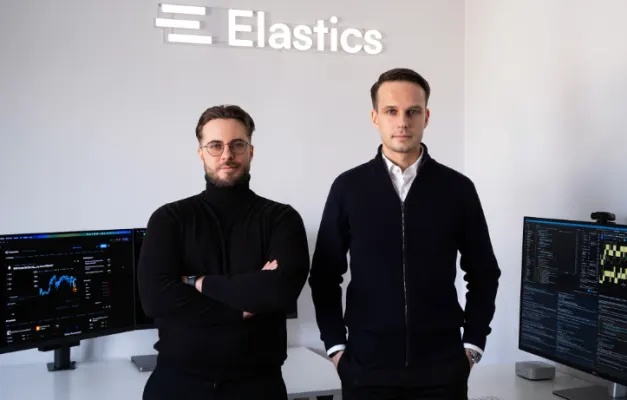

Warsaw-based startup Elastics has raised $2 million in a pre-seed round led by Frst, with participation from angel investors including Mati Staniszewski and Piotr Dąbkowski.
Founded in 2025 by Szymon Pawica and Mateusz Brodowicz, the company is building an AI layer on top of prediction markets such as Polymarket and Kalshi. Its product allows users to automate trading workflows — from research to execution — including a feature that turns natural language prompts into trades.
The timing aligns with a broader rise in prediction markets. “Wars, elections, Fed decisions, and policy shocks have turned the news cycle into a continuous market event,” said Pawica, pointing to sustained trading volumes following the 2024 US election. He also noted a shift in user behaviour, with participants coming from sports betting platforms and drawn by simpler formats: “You read the question, pick a side, and the price is the implied probability.”
Elastics is currently focused on more advanced users running multiple positions rather than beginners. At that level, complexity becomes the main constraint. “They can’t track correlation across the book, can’t keep up with news on every position, and it’s easy to lose sight of which theses are still intact,” Pawica said.
The company operates as an execution and intelligence layer, integrating with existing platforms via APIs and blockchain data rather than building its own exchange. “We currently sit as an intelligence and execution layer on top of their rails. We connect via their public APIs, reading market data and routing trades through them,” he explained.
Geographically, Elastics is prioritising the US, where regulatory conditions for prediction markets have recently improved, while Europe remains more restrictive. The product is currently in private beta, with a wider launch planned later this year.
The fresh capital will be used to expand Elastics’ engineering and quantitative teams in Poland and accelerate product development ahead of the public launch.
“The quant edge at hedge funds comes down to people and infrastructure,” Pawica added. “We think AI can now replicate most of that and make it available to anyone.”


