
For years, startup investing was seen as a choice between different routes. Founders could go to VCs for structured processes, access to institutional capital, and long-term support through many stages of growth; they could also find angel investors, experienced operators often with knowledge of their field, who write personal cheques and back them at the earliest stages. Yet it seems like, as the European VC ecosystem evolves, this distinction becomes less relevant.
The question is no longer whether angel investors or venture funds create more value. Increasingly, the strongest startup ecosystems are those where founders, angels, syndicates, LPs, and VC funds play complementary roles and create interconnected networks that help companies grow at every stage.
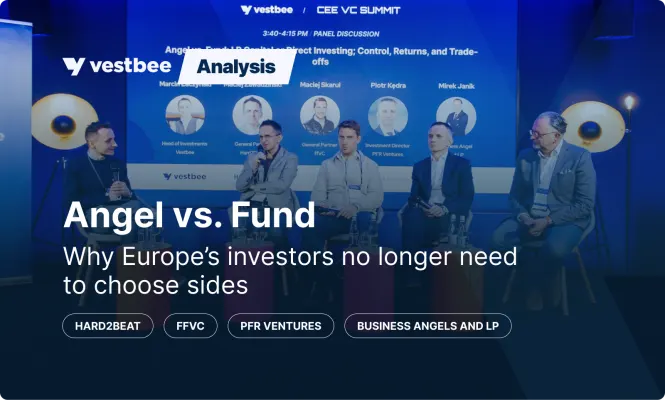
What else did investors from Vestbee Angels, Hard2Beat, ffVC, PFR Ventures, and the business angel community discuss at Vestbee's CEE Summit? Read on.
You have €1 million to invest in a startup — what would you do?
Imagine you have €1 million available for startup investing. Should you deploy it directly as an angel investor or allocate it to venture capital funds? Neither approach is sufficient on its own.
While direct investing offers the potential for higher returns and greater involvement, it also introduces concentration risk, limited deal flow, and substantial time commitments. Venture funds, on the other hand, provide diversification and professional portfolio management but limit the investor's ability to leverage personal expertise and networks.
Increasingly, experienced investors favour a blended strategy — allocating a part of the capital through funds, and dedicating the rest for a more concentrated support of startups in the domain they have the most expertise.
According to Maciej Zawadzinski, General Partner at Hard2Beat, a balanced approach could involve deploying 20–30% of capital directly into startups while allocating the majority through venture funds.

The rise of syndicates and the institutionalisation of angel investing
The convergence of angel investing and venture capital is already visible across Europe. Some VC firms actively leverage angel communities as part of their sourcing and support strategies, while others are creating investment vehicles that formalise what was once informal angel activity.
b2venture, for example, has built one of Europe's most active angel investor communities alongside its venture funds, demonstrating how angel networks can become an integral part of a firm's sourcing and support strategy. Meanwhile, Barcelona-based Masia raised a €20 million angel fund in 2025 and plans to back 60 pre-seed and seed startups, illustrating how informal angel investing is becoming increasingly structured and institutionalised.
Syndicates are another manifestation of this trend. Historically, angel investing was largely an individual activity, but syndicates such as Vestbee Angels are emerging as an intermediary layer between traditional angel investing and institutional venture capital. They give investors access to curated deal flow, shared due diligence, and competitive funding rounds without requiring the same level of time commitment as direct investing. As startup ecosystems mature, informal angel investing is gradually evolving into a more organised, collaborative, and professionalised model.
Angel investors win on domain expertise
One of the key advantages angel investors bring is domain expertise. As startup markets become more crowded and specialised, identifying breakout companies increasingly requires deep sector knowledge rather than intuition alone. A former fintech founder, for example, may recognise emerging trends, evaluate products more effectively, and gain access to promising startups long before they appear on the radar of larger venture funds.
However, expertise alone is not enough to build a successful investment portfolio. Concentrated knowledge can help investors spot winners in a particular sector, but it does not eliminate the need for diversification across industries, stages, and market cycles. This is one reason many experienced investors combine direct angel investing with fund exposure, using one to leverage their expertise and the other to spread risk.
The challenge is that direct investing requires more than capital. Evaluating startups, conducting due diligence, supporting founders, making follow-on decisions, and maintaining relationships across a portfolio of companies can quickly become a significant commitment.
As Piotr Kędra, Investment Director at PFR Ventures, put it: "If you want to be passive, then you should be an LP. If you want to be active, you should be an angel."
In other words, the choice between angel investing and fund investing is not only about risk and returns, but also about how much time and involvement an investor is willing to commit.
VCs offer access to follow-on capital instead
Even as business angels possess operational advantages, the discussion highlighted one area where venture funds continue to hold a clear edge: follow-on investing. The companies that generate the majority of returns often require multiple rounds of financing before reaching scale. Investors who can continue supporting those companies through subsequent rounds are better positioned to maintain ownership and capture long-term value creation. Angels may lack the capital needed to participate in later rounds, and as valuations increase, maintaining ownership becomes increasingly difficult.
The future of startup investing is not about choosing between angels and funds. It is about building ecosystems where both can work together — combining specialised expertise, diversified capital, and long-term support to help companies grow from pre-seed to scale. And this is great news for founders.