
In 2026, CEE’s venture market is showing several clear patterns. Since 2024, the number of deals in the CEE region has fallen by roughly half, yet 2026 is on track to deliver the highest total funding volume of the past three years. At the same time, the sector long associated with the region's largest rounds, deeptech, is becoming increasingly focused on one of Europe's fastest-growing investment themes: security and defence.
To understand how the market is changing, we analysed Vestbee and Dealroom data across investment stages, funding rounds, and sectors.
All 2026 figures are year-to-date and reflect activity through mid-July, representing approximately 54% of the calendar year.
Deal volume is shrinking, but not evenly across stages
CEE startups raised capital across 935 rounds in 2024, 784 in 2025, and 244 so far in 2026, putting the current year on pace for roughly 450 deals. Funding volumes, however, have remained comparatively stable: €2.2 billion in 2024, €2.1 billion in 2025, and €1.4 billion year-to-date in 2026. According to our assessment, if current trends hold, the region could surpass €2.6 billion by year-end, suggesting that capital is increasingly flowing into fewer, larger transactions.
A closer look at the stage distribution reveals where the contraction in deal activity is happening.
- Pre-seed has seen the sharpest pullback, declining from 697 rounds in 2024 to 563 in 2025, with just 132 recorded so far in 2026. Based on our annual estimate, the category would still finish the year more than 50% below its last year's level.
- Seed investment is following a similar trajectory, but at a slower pace.
- Series A segment has remained notably stable, with 70 rounds completed in both 2024 and 2025, and 2026 tracking toward a comparable total.
- Growth-stage activity, while limited in absolute numbers, is moving in the opposite direction: Series B and later rounds increased from 23 deals in 2024 to 28 in 2025 and are on pace to reach approximately 30 this year, making it the only stage to post consecutive annual growth.
There is an important methodological caveat: early-stage transactions, particularly pre-seed rounds, are often announced months after they close and can take time to appear in venture databases. Larger deals, by contrast, are typically disclosed immediately and captured in near real time. While 2026 pre-seed figures will likely be revised upward over the coming months, we can already see the pattern: the CEE market is producing fewer early-stage deals, while later-stage companies continue to attract sustained investor interest.
Capital is becoming even more concentrated in 2026
At first glance, the rise in headline funding figures might suggest that venture capital in CEE is inflating, but even as the region's largest rounds are becoming bigger each year, the average cheque sizes within individual funding stages have remained remarkably stable over the past three years.
Series A rounds have consistently landed between €7.0 million and €7.6 million, Series B between €23.3 million and €23.7 million, and seed rounds around the €2 million mark.
In other words, there is actually no evidence of widespread cheque size inflation across the venture ecosystem. Instead, we observe that the capital is becoming increasingly concentrated in the region’s largest deals
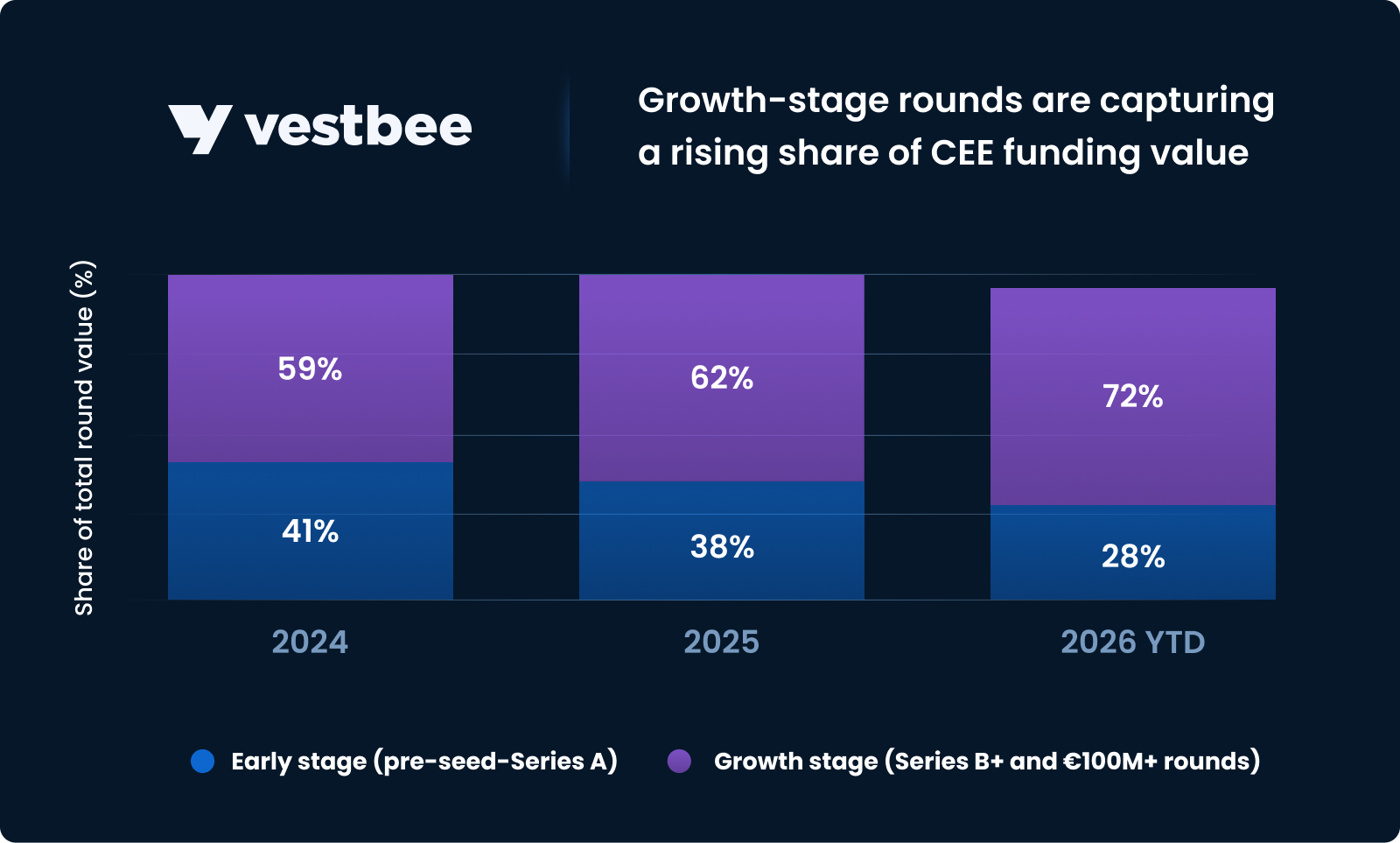
Growth-stage rounds — defined here as Series B, Series C, and rounds exceeding €100 million — accounted for 59% of CEE funding in 2024, 62% in 2025, and 72% so far in 2026. Meanwhile, early-stage companies, despite representing more than 90% of all deals by count, have seen their share of total capital decline from 41% to just 28%
What is more, the trend of a small group of companies attracting a disproportionate share of available funding is set to continue in 2026. In 2024, the 13 largest rounds accounted for approximately half of all capital invested across CEE. That figure dipped slightly to 45% in 2025 before surging to roughly 68% in 2026.
This year also saw the region’s first €250 million+ venture round recorded since 2022, as Mews raised $300 million in a Series D.
Defence tech and dual-use
Deeptech has long dominated CEE's biggest funding announcements. In 2024, companies spanning energy storage, hydrogen, robotics, and space made up half of the year's largest rounds, including InoBat, Sunly, Stargate Hydrogen, Elcogen, Verne, Starship, and Kontakt.io. The pattern continued in 2025, with names such as Tachyum, EnduroSat, Aerones, Nomagic, and Dronamics featuring prominently.
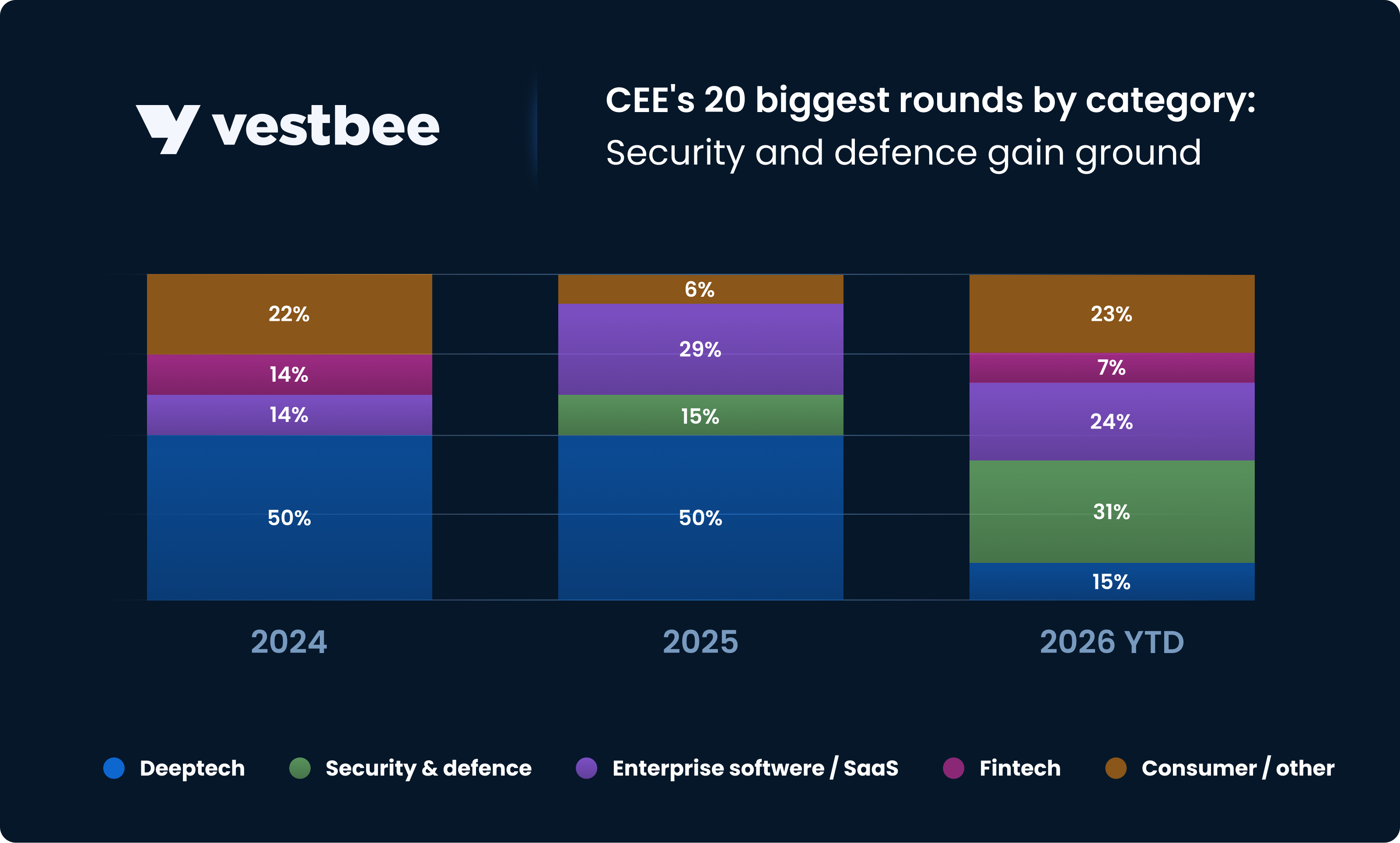
In 2026, however, deeptech's share of the largest deals has fallen to roughly 15%, as security and defence have emerged as the region's defining investment theme, accounting for four of the year's 13 largest rounds: Cyber Swarm, Uforce, Alcatraz AI, and Frankenburg, each raising approximately $50 million or more. It’s worth noting, however, that some of these companies can be classified as deeptech. The distinction reflects their specific focus on defence and dual-use rather than a clear separation from the broader deeptech category.
Vertical AI
The Dealroom data shows us that AI is present across nearly every sector, but rarely appears as a standalone category. In all three years, it has primarily served as an enabling technology embedded across areas such as fintech and robotics, energy and security. Rather than replacing established verticals, AI is becoming a part of the underlying infrastructure of the CEE venture market.
Early stage in name only
Some of the largest security and defence deals are still formally classified as early-stage rounds. CyberSwarm's $50 million raise is recorded as a Series A, while Uforce's equivalent round is categorised as a seed. Frankenburg's €30 million funding also falls under Series A.
CEE has seen unusually large early-stage rounds before: Verne raised €100 million at Series A in 2024, while Rentberry secured $90 million the same year. However, such outsized deals appear to become a pattern.
What's different in 2026 is the concentration of capital. Investors are increasingly deploying growth-stage money at companies; first institutional rounds, particularly in security and defence.
This dynamic is what conventional market analysis often overlooks: when deals are grouped by round size alone, these companies are placed alongside later-stage businesses, obscuring just how early investors are willing to place increasingly large bets on the sector.
What does this suggest for the rest of 2026 and 2027?
Taken together, the data points to a venture market that is becoming increasingly concentrated. Growth-stage companies are capturing a larger share of total funding, even as overall deal activity declines. Average round sizes across traditional venture stages have remained largely unchanged, while the biggest deals continue to push new records. At the same time, the focus of these investments has shifted from broad-based deeptech to a more focused cluster of security and defence companies.
The more important question is what is happening earlier in the pipeline. If the decline in pre-seed activity persists, today's strength at the growth stage could eventually leave the CEE market with fewer venture-backed companies ready to scale.
For now, the numbers capture a region in transition: more capital flowing into fewer companies, larger bets being placed on security and defence, and growing uncertainty over the resilience of CEE’s early-stage ecosystem.